
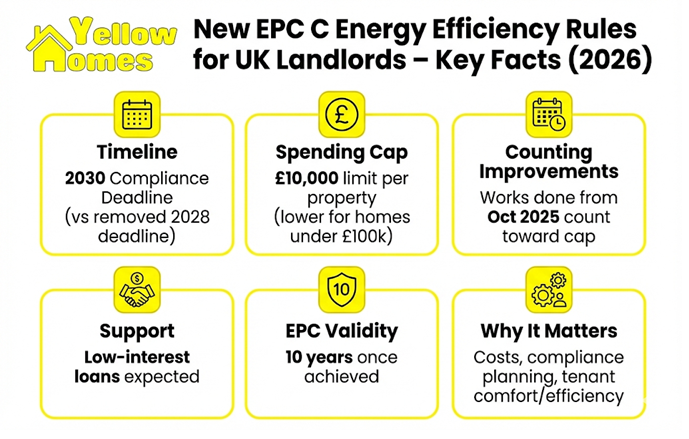
EPC C requirements for landlords are changing — and for UK property investors, the Government’s revised plans are a welcome move toward a more practical, commercially realistic framework for energy efficiency in the private rented sector.
Earlier proposals suggested landlords could face bills of up to £15,000 per property and a tight 2028 deadline for new tenancies. Following industry consultation and lobbying led by organisations such as the NRLA, the Government has now introduced a revised plan that balances sustainability with investment performance.
If you own, manage, or invest in rental property, understanding the EPC C requirements for landlords is now essential for protecting long-term asset value, compliance, and rental performance.
The Big Picture: EPC C Remains the Target
The Government’s objective hasn’t changed: rental homes should be warmer, cheaper to run, and more sustainable. All privately rented properties will still be expected to achieve an Energy Performance Certificate (EPC) rating of at least C.
What has changed is the timeline, the cost burden, and how improvements are counted.
Instead of forcing rushed upgrades, the new framework gives landlords more time and clearer financial limits.
The updated EPC C requirements for landlords mean energy efficiency is no longer optional — it is now a core part of long-term rental asset management.
Key Changes Landlords Need to Know
✅ The 2028 Deadline Has Been Removed
Previously, landlords signing new tenancies would have needed EPC C by 2028. That early deadline has now been scrapped.
Instead, all landlords — whether with new or existing tenants — have until 1 October 2030 to comply (or register a valid exemption).
This removes the risk of properties being forced off the market prematurely.
✅ Spending Cap Reduced to £10,000
The maximum amount landlords can be required to spend on upgrades has been cut from £15,000 to £10,000 per property.
In addition:
-
Properties valued under £100,000 will have lower incremental caps.
-
This helps protect landlords operating in lower-value regions from disproportionate costs.
Once the cap is reached, landlords can register an exemption if EPC C still cannot be achieved.
✅ Recent Improvements Will Count
Any qualifying energy efficiency improvements made from October 2025 onward will now count toward the spending cap.
That means:
-
If you’ve already invested in insulation, glazing, heating, or efficiency upgrades, that spend isn’t wasted.
-
Strategic improvement planning now makes much more sense commercially.
✅ EPCs Will Last 10 Years
Under the revised plans, EPCs will be valid for 10 years (previously shorter under some proposals).
So, if your property achieves EPC C:
-
You are recognised as compliant for a full decade.
-
Any EPC C or higher achieved up to October 2029 will benefit from this protection window.
This gives landlords confidence that upgrades won’t immediately be undermined by regulatory changes.
✅ Funding Support Is Coming
The Government has indicated support through:
-
Low-interest loans for energy efficiency works.
-
Continued funding through schemes like the Boiler Upgrade Scheme (supporting heat pumps).
-
The wider Warm Homes Fund, depending on local authority area.
While details are still emerging, the direction of travel is toward partnership rather than punishment.
Why This Matters for Property Investors
There are currently an estimated 2.5 million rental homes in England that will need improvement to meet EPC C.
At the same time, the UK faces a shortage of skilled retrofit trades, expected to reach around 250,000 workers by 2030.
This creates two realities:
-
Energy efficiency is becoming part of long-term asset value, not just compliance.
-
Investors who plan early will outperform those who react late.
At Yellow Homes, we already treat EPC strategy as part of LDV – Long-Term Development Value. Energy efficiency improves:
-
Tenant comfort
-
Running costs
-
Rentability
-
Asset resilience
-
Exit value
It’s no longer just about ticking a box — it’s about future-proofing investments.
The Government’s “Fabric First” Approach
The revised framework focuses on what’s called a “fabric first” strategy.
Instead of jumping straight to expensive technology, priority is given to:
-
Insulation
-
Window upgrades
-
Draught proofing
-
Structural heat retention
These upgrades usually deliver the biggest EPC gains for the least disruption and cost.
For landlords, this means planning sensible, staged improvements rather than chasing headline tech solutions.
What Should Landlords Do Now?
Meeting the EPC C requirements for landlords should be treated as part of any acquisition, refurbishment, or conversion strategy, not a last-minute compliance exercise.
If you own rental property, now is the time to:
-
Review your current EPC ratings
-
Identify properties below C
-
Cost out insulation and efficiency upgrades
-
Track spend from October 2025 onward
-
Build EPC strategy into refurb and conversion projects
At Yellow Homes, EPC planning is integrated into every acquisition and refurbishment decision we make — ensuring compliance, performance, and commercial viability all align.
Final Thoughts
Ultimately, the revised EPC C requirements for landlords are about future-proofing UK rental property, improving tenant comfort, and protecting investor returns over the long term.
The revised EPC C proposals represent a shift toward realism.
Yes, there is still a significant task ahead, but the new rules provide:
-
More time
-
Lower cost caps
-
Better recognition of past investment
-
A clearer compliance pathway
For investors, this reinforces one key message: energy efficiency is now part of asset management, not just regulation.
If you’d like to understand how EPC strategy fits into high-yield HMO and residential investment, or how it impacts your own portfolio, feel free to get in touch with the Yellow Homes team.
Follow our project updates on Facebook and Instagram where we share real site progress from our developments.